


Page 4 - October_Newsletter_2017
P. 4
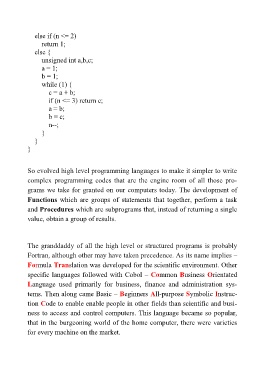
else if (n <= 2)
                  return 1;
              else {
                  unsigned int a,b,c;
                  a = 1;
                  b = 1;
                  while (1) {
                      c = a + b;
                      if (n <= 3) return c;
                      a = b;
                      b = c;
                      n--;
                  }
              }
          }


          So evolved high level programming languages to make it simpler to write
          complex  programming  codes  that  are the engine  room  of  all  those  pro-
          grams we take for granted on our computers today. The development of
          Functions which are groups of statements that together, perform a task
          and Procedures which are subprograms that, instead of returning a single
          value, obtain a group of results.


          The granddaddy of all the high level or structured programs is probably
          Fortran, although other may have taken precedence. As its name implies –
          Formula Translation was developed for the scientific environment. Other
          specific languages followed with Cobol – Common Business Orientated
          Language  used  primarily  for  business,  finance  and  administration  sys-
          tems. Then along came Basic – Beginners All-purpose Symbolic Instruc-
          tion Code to enable enable people in other fields than scientific and busi-
          ness to access and control computers. This language became so popular,
          that in the burgeoning world of the home computer, there were varieties
          for every machine on the market.

