


Page 4 - Newsletter_October_2025
P. 4
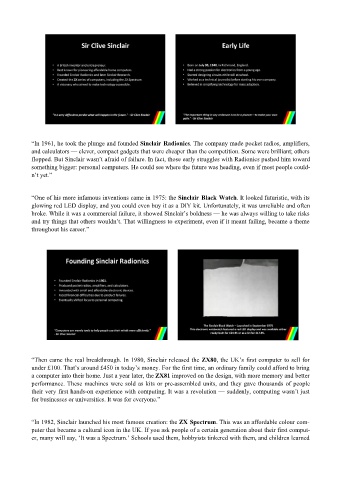
“In 1961, he took the plunge and founded Sinclair Radionics. The company made pocket radios, amplifiers,
            and calculators — clever, compact gadgets that were cheaper than the competition. Some were brilliant; others
            flopped. But Sinclair wasn’t afraid of failure. In fact, those early struggles with Radionics pushed him toward
            something bigger: personal computers. He could see where the future was heading, even if most people could-
            n’t yet.”

            “One of his more infamous inventions came in 1975: the Sinclair Black Watch. It looked futuristic, with its
            glowing red LED display, and you could even buy it as a DIY kit. Unfortunately, it was unreliable and often
            broke. While it was a commercial failure, it showed Sinclair’s boldness — he was always willing to take risks
            and try things that others wouldn’t. That willingness to experiment, even if it meant failing, became a theme
            throughout his career.”


            “Then came the real breakthrough. In 1980, Sinclair released the ZX80, the UK’s first computer to sell for
            under £100. That’s around £450 in today’s money. For the first time, an ordinary family could afford to bring
            a computer into their home. Just a year later, the ZX81 improved on the design, with more memory and better
            performance. These machines were sold as kits or pre-assembled units, and they gave thousands of people
            their very first hands-on experience with computing. It was a revolution — suddenly, computing wasn’t just
            for businesses or universities. It was for everyone.”


            “In 1982, Sinclair launched his most famous creation: the ZX Spectrum. This was an affordable colour com-
            puter that became a cultural icon in the UK. If you ask people of a certain generation about their first comput-
            er, many will say, ‘It was a Spectrum.’ Schools used them, hobbyists tinkered with them, and children learned

